It's early November, and Yosemite's Tioga Road and Glacier Point Road could close for the season any day; this year foreign visitors also pay an extra $100 each. This guide puts Yosemite's summer and winter side by side: what winter takes away (Tioga Road, Glacier Point Road, the Mariposa Grove shuttle), what it adds (snowy valley views, Yosemite Falls flowing again, February's firefall), which road to take in winter, what to do when your rental company won't supply chains, whether two people should pay $235 at the gate or buy the $250 annual pass, fuel and EV charging (no gas in the valley, Level 2 only in the park), a one-day plan, and where to stay.
Key facts
- November to March, carry chains, whatever you drive.
- In winter, take Highway 140 in, and fill up and charge before you climb.
- Three or more adults, or a second popular national park on this trip, buy the 250-dollar annual pass.
- Winter in Yosemite takes away two roads and gives you a whole quiet valley. Information as of early November 2026; check the park website and the road line again before you go.
Video coming soon · Subscribe on YouTube
Reading the map
First, one minute to understand the map.
Yosemite sits in the Sierra Nevada in central California. Most visitors head for the valley in the middle, Yosemite Valley, about 1,200 meters up. Half Dome, El Capitan and Yosemite Falls all line this valley.
Three highways come in from the west. To the south, Highway 41 climbs from Fresno and Oakhurst to the South Entrance. In the middle, Highway 140 follows the river canyon from Merced and Mariposa to the Arch Rock Entrance. To the north, Highway 120 comes from the San Francisco Bay Area.
Keep going east on 120 and you're on Tioga Road, crossing a pass at about 3,000 meters down to the east side. In summer, many people coming from Las Vegas or Death Valley drive in this way. In winter, that door is shut.
What winter takes away
The bad news first. Winter takes away three main things.
One: Tioga Road. Officially it usually closes sometime in November. Once it does, no cars between Crane Flat and Tioga Pass, and Tuolumne Meadows closes too. There's no road into the park from the east.
If you're coming from Las Vegas or Death Valley in winter, you have to go around the south, up through Bakersfield and Fresno. It's a much longer drive, so plan ahead.
Two: Glacier Point Road. It also usually closes in November. From mid-December to early April it's plowed only as far as Badger Pass Ski Area. Glacier Point itself is reachable in winter only on skis or snowshoes. That classic view down onto Half Dome can't be reached by car in winter.
Three: the giant sequoias. The free shuttle to the Mariposa Grove near the South Entrance runs until about late November. After that, you walk up the Washburn Trail from the parking area: about 3 km one way, around 150 meters of climbing, possibly snowy or icy.
A few smaller things: the Half Dome cables are down, so no summit in winter, and most valley campgrounds are closed.
After all that, winter may sound like half a park. But this next part is something summer doesn't have.
What winter adds
The first thing winter adds is snow.
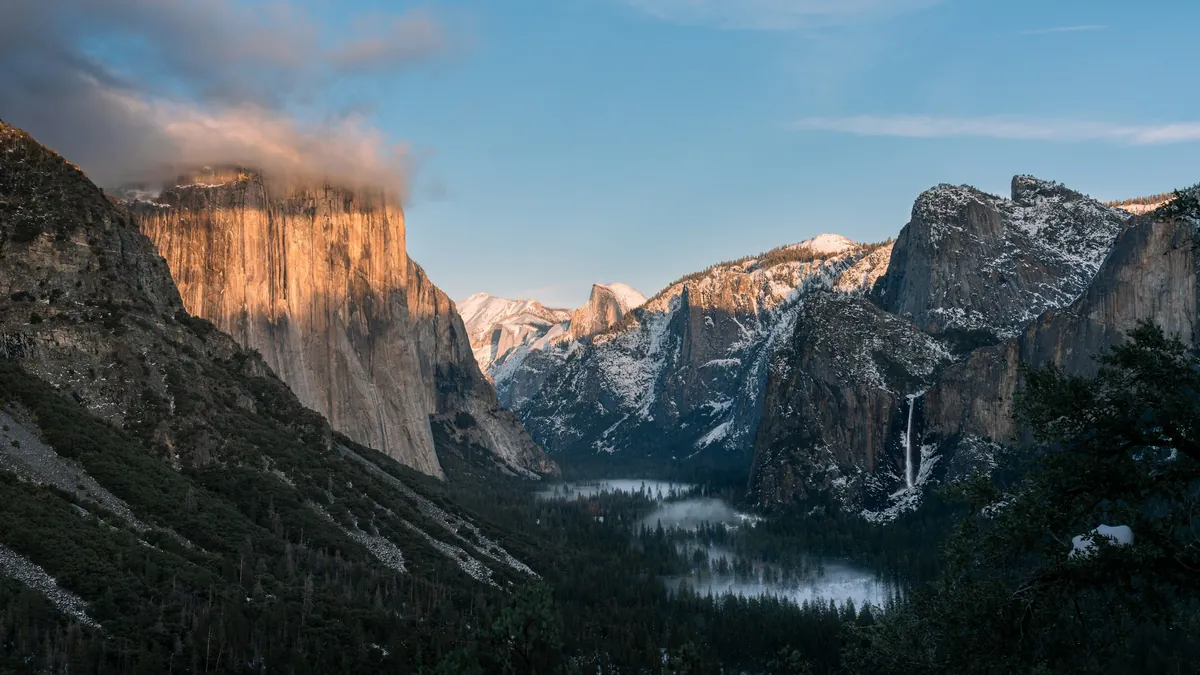
After a snowfall, look into the valley from Tunnel View: El Capitan, Bridalveil Fall, Half Dome in the distance, all white. In summer this spot is packed. On a winter morning there are often just a few photographers with tripods.
The second is water. Late in summer, Yosemite Falls often thins out or even stops. The park says that once winter snow and rain arrive, the falls start flowing again, though not at springtime levels.
The third is fewer people. One exception: around Christmas and New Year's the park can get very crowded, with traffic and hard-to-find parking.
The fourth is winter-only fun. Badger Pass Ski Area opens in the snow season for skiing and snow tubing, and while it's open, rangers lead snowshoe walks. In past winters, Curry Village has also set up an outdoor ice rink facing Half Dome. Whether and when it opens this year, check the park's seasonal notices.
And finally, the firefall. In mid to late February, if skies are clear and Horsetail Fall has water, for a few minutes before sunset the light catches the fall from behind and it glows like lava. For the 2026 season no reservation was needed to see it, but there were traffic restrictions, so you may park farther away and walk more. Next year's rules are usually announced in January.
Which entrance in winter
If you're going in winter, the first decision is which road.
My advice: in winter, prefer Highway 140, from Merced and Mariposa to the Arch Rock Entrance. It's the lowest route, following the river canyon, and less likely to collect snow than 41 or 120. Mariposa County's tourism site says it stays snow-free more often than the other routes.
That doesn't mean 140 never needs chains. In a really cold storm, the stretch outside the park can have chain controls too.
The other two, 41 and 120, are higher and often snowy before you even reach the park. Coming from Los Angeles take 41; from San Francisco take 120. Both work, just allow more time and check conditions.
Before you go, call the park's road line: 209-372-0200, press 1, then 1 again, for that day's road and chain information.
Chains: the rental company says no, the park says carry them
Now the second question from the start.
First, the park's rule. Yosemite says chains are often required from November through March. When chain controls are in effect, every vehicle must carry chains and know how to use them, whatever you drive. Four-wheel drive is no exception. The park even states that rental cars are not exempt, even with all-season tires.
Chain controls have three levels. R1: ordinary cars need snow tires on the drive wheels, or chains. R2: four-wheel drive with snow tires on all four can skip chains. R3: no exceptions, every vehicle chains up.
Ignore it and the fine can reach 5,000 dollars. Get stuck without chains and you may wait hours for a tow truck to bring them, paying hundreds of dollars, and AAA doesn't cover it.
Now the rental companies. Enterprise, for example, says it doesn't supply chains, and they can't be put on its cars unless state law requires them. California chain controls are a legal requirement. So when controls are in effect, chaining up as required is allowed. But rules differ by company and branch, so ask in person at pickup, and ideally get it in writing on the contract.
Where do you get chains? Rental companies generally don't supply them and they're hard to rent near the park, so you'll mostly need to buy. Auto parts stores and gas stations in towns like Mariposa, Oakhurst and Merced sell them; buy for your car's tire size. The valley garage and the Wawona gas station have some, but stock is limited.
If you'd rather not drive on snow at all, there's another option: park at a bus stop along Highway 140 and ride YARTS, the regional bus, into the park. It costs a fare, but no chains to worry about. And for now, bus riders aren't charged the 100-dollar foreign visitor surcharge.
Fees: 235 for two, or a 250 annual pass?
Now the first question.
Yosemite's entrance fee is 35 dollars per private vehicle, good for seven days, covering everyone inside. Since January 1, 2026, nonresidents aged 16 and up pay an extra 100 dollars each. So two adults in one car pay 35 plus 200: 235 dollars. Three adults: 335.
The other option is the America the Beautiful annual pass for nonresidents: 250 dollars, free entry to every national park for a year, one pass per private vehicle, and the 100-dollar surcharge is waived for everyone in the car.
So the math is simple. Three or more adults: the pass wins on the first visit. Two adults visiting only Yosemite: paying at the gate is 15 dollars cheaper. But if this trip includes a second park on the list, like the Grand Canyon, Zion, or Sequoia and Kings Canyon just to the south, the pass saves you more than 200 dollars.
Three small things: no cash, only cards and mobile pay; IDs are checked at the gate, so carry your passport; and fee-free days don't apply to nonresidents.
Fuel and charging
In the mountains in winter, fuel and charge matter even more than in summer.
Fuel: there is no gas station in Yosemite Valley. The three nearest: El Portal, just outside the park, about 24 km from the valley; Crane Flat, about 27 km; and Wawona, about 45 km. All three have 24-hour pay-at-the-pump. My advice: fill up in a town below, then drive in.
Charging: inside the park there is only Level 2, no fast charging. In the valley: 20 at Curry Village, 10 at Yosemite Falls parking, 8 at Yosemite Valley Lodge, 6 at The Ahwahnee, 4 by the Welcome Center. They all charge a fee now, about 37 cents per kWh, plus a per-minute idle fee if you don't move after 10 minutes. Best for charging overnight.
Fast charging happens below. On Highway 41, Oakhurst has a Tesla Supercharger with 8 stalls up to 325 kW, opened in late 2025, and Fish Camp outside the South Entrance has Superchargers too.
On Highway 120, at Buck Meadows about 20 km from the park, Electrify America has fast chargers up to 350 kW. Stations change, so check your charging app before you go. Along Highway 140 fast chargers are scarce, so top up in Merced first.
One more thing: cold weather cuts battery range, and the heater uses power too. In winter, keep a bigger buffer; don't plan it down to the last mile.
A winter day
If you only have one day, here's how I'd do it.
In the morning, enter on Highway 140 through Arch Rock and drive straight to Tunnel View for the snowy valley panorama. Then drop to the valley floor and stop along the way at Bridalveil Fall and El Capitan Meadow.
On weekends and holidays, valley lots can fill by late morning. Once you've parked, stay put and use the free valley shuttle, which runs every day, year-round, from 7 am to 10 pm.
At midday, walk the flat trail to the base of Yosemite Falls and see it flowing again. In the afternoon, head to Curry Village, where in past winters there's been an ice rink. Before sunset, go back to Tunnel View or Valley View and wait for the last light on El Capitan.
Drive slowly. In 2024, at least 21 bears were hit by vehicles in the park. Winter days are short and roads can ice over, so start the last drive down early.
Where to stay
In winter you have three choices inside the park: The Ahwahnee, Yosemite Valley Lodge and Curry Village. You can book up to a year ahead.
For camping, few campgrounds stay open in winter. In the valley, Upper Pines and Camp 4 need reservations; Hodgdon Meadow to the north is first-come, first-served.
Outside the park, stay in El Portal or Mariposa on Highway 140, or Fish Camp and Oakhurst on Highway 41. It's cheaper, easier to book and easier for charging; the trade-off is more mountain driving every day, and more time to allow when it snows.
General information only. Rules change; check official notices before you go.
Routes, parking and gas stations, shown on maps and real footage, one section at a time.